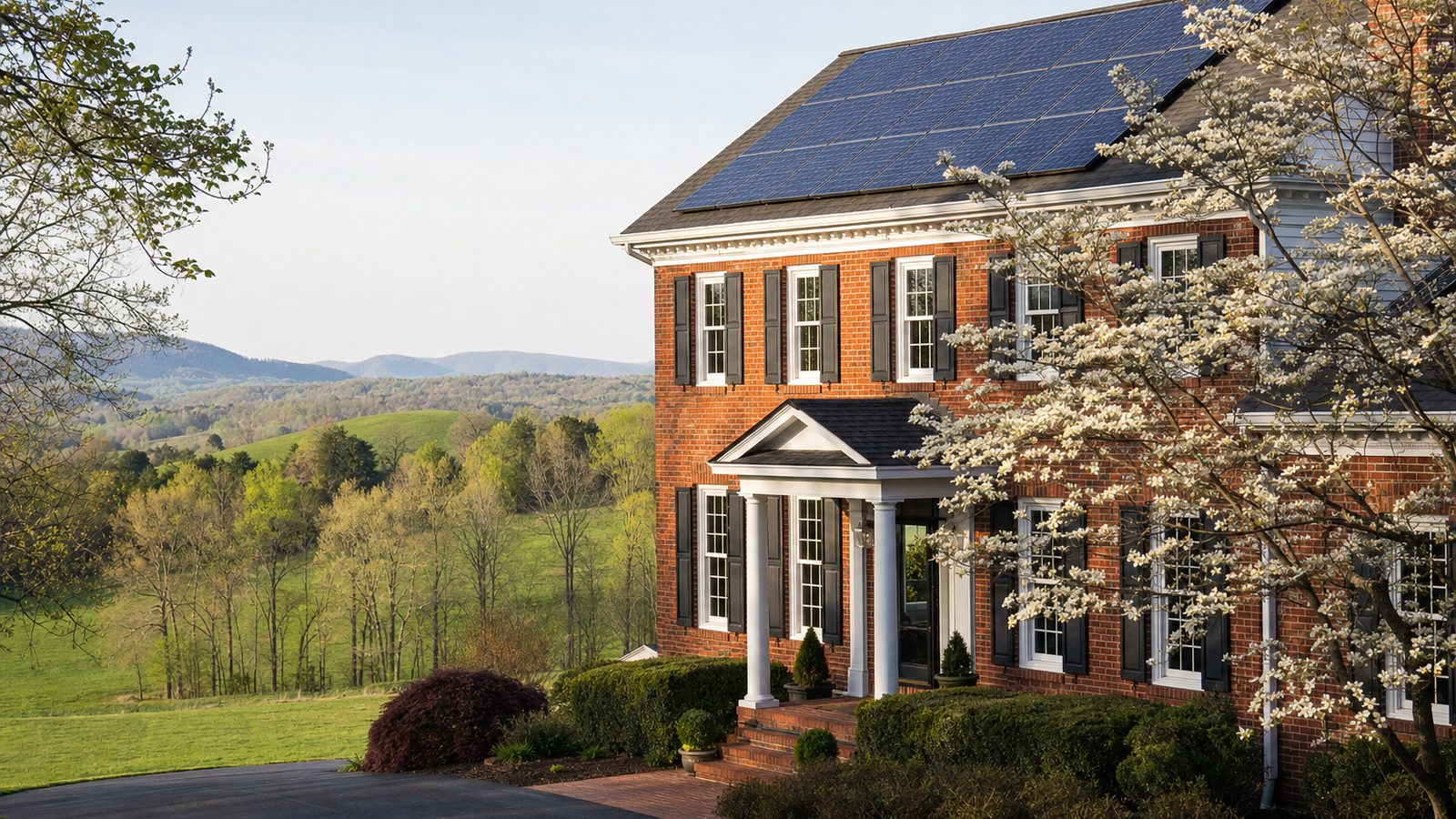
Virginia
Virginia solar in 2026
Virginia is not a state where the policy rug moved under the homeowner in 2026. Dominion NEM 2.0 kept twelve-month netting, and the SCC rejected proposed application fees. That is a real advantage. The less glamorous detail is annual surplus: it settles at avoided cost plus 1 cent per kWh. Build to your load, not to a sales rep's largest roof sketch.
Virginia utility pricing changes how a roof should be sized
Virginia's rate and modeled production make solar viable without exotic assumptions. The deciding variable is the annual settlement. A close load match can use the twelve-month account; chronic overproduction ends up with the utility at a sharply weaker value.
| Energy source | Type | Average price | What that means |
|---|---|---|---|
| Virginia statewide blend | Electricity | 17.61¢ per kWh | Virginia's EIA residential statewide average through May 2026. |
| Residential natural gas | Natural gas | $23.66 per Mcf | Household gas figure from EIA for May 2026, roughly 7.8 cents per thermal kWh. |
| Rooftop solar, owned | Electricity | ~7.4¢ per kWh | Ownership-cost estimate across 25 years using EnergySage pricing and our PVGIS modeling. A solar unit sent away from the house can carry a lower value. |
The electric benchmark comes from EIA Table 5.6.A, May 2026. Virginia household gas is from the EIA price series for that month; one Mcf is about 304 kWh of thermal energy. Our solar calculation is described on the methodology page.
Virginia output has a real regional spread
This is a geographic question, not a simple solar yes-or-no. Virginia Beach represents the high case and Alexandria the low case in this model. That gap is large enough to challenge any fixed production promise that ignores the actual roof.
| Modeled city | Annual kWh from each installed kW | Expected yearly output at 13.95 kW |
|---|---|---|
| Virginia Beach | 1,455 | 20,303 kWh |
| Richmond | 1,425 | 19,879 kWh |
| Roanoke | 1,396 | 19,474 kWh |
| Alexandria | 1,339 | 18,673 kWh |
Method: PVGIS v5.2 model runs by Solar Learning Lab on August 18, 2026, using the NSRDB radiation database. Assumptions: fixed roof mount, south facing, 30 degree tilt, 14 percent losses. Your roof will differ. The example matches the EnergySage Virginia average system of 13.95 kW.
Dominion's new rules keep the annual ledger intact
In May 2026, the SCC approved Dominion Energy's NEM 2.0. The decision kept full-retail annual netting, set a $1 monthly administrative charge, and turned down Dominion's requested application fees. The Virginia Clean Economy Act program limit is 6 percent of peak load. For a year of tighter export policies elsewhere, that continuity matters.
The true-up deserves more attention than the headline rule. Excess at year end is settled at avoided cost plus 1 cent for each kWh rather than the household retail price. The annual window is helpful flexibility, not permission to inflate the array. Insist on the projected surplus alongside total generation.
Policy source: NEM 2.0 decision coverage.
Virginia's tax rule is useful, but it has boundaries
| Item | Value | Fine print |
|---|---|---|
| Solar equipment tax exemption | Statutory treatment for systems of 25 kW DC or less | Systems inside the statutory limit are wholly exempt from state and local taxation (Va. Code § 58.1-3661) |
| Federal 25D | Ended December 31, 2025 | Providers using leases or PPAs may claim 48E and pass some value through pricing (CRS) |
Our research identifies no Virginia residential rebate or income-tax credit. The dependable benefit is the statute's tax treatment, not a made-up rebate that merely dresses up a sales price.
Virginia's stable rule still demands a precise design
Dominion's NEM 2.0 is unusually close to its predecessor: twelve-month netting stayed in place, the SCC rejected proposed application fees, and the recurring administrative fee is $1 each month. That is real predictability. It does not mean every Virginia utility follows the same path. A quote should identify Dominion, Appalachian Power, or the relevant cooperative before it uses a policy assumption.
The annual settlement is the line that keeps sizing honest. Monthly credits can be carried through the twelve-month period, but unused annual generation settles at avoided cost plus 1 cent per kWh. Ask for two production figures: the total forecast and the expected annual excess. The difference is not a technicality. It is the part of the system that will not avoid a normal retail purchase.
Tax treatment belongs in a separate column from utility savings. Va. Code § 58.1-3661 states that qualifying solar facilities under §15.2-2288.7(A) or (B), with nameplate capacity not more than 25 kW DC, are wholly exempt from state and local taxation. It also provides a local-option route for certified equipment. Get the scope matched to the exact project rather than assuming the label "residential" settles it.
A proposal that says "Virginia net metering" without naming the utility is unfinished. Dominion Energy Virginia is the utility covered by the NEM 2.0 decision discussed here, while Appalachian Power and rural cooperatives serve other parts of the state. The SCC's net-metering program page confirms the program, but the household still needs its own utility's interconnection terms. That is why a good proposal identifies the territory first, the annual production second, and the settlement assumption third. Reversing that order makes the savings forecast look cleaner than the actual decision.
Rule details: NEM 2.0 coverage. Tax statute: Va. Code § 58.1-3661.
Use a Virginia load case, not an export fantasy
This calculator starts with ordinary household use rather than a surplus-production strategy. Test a system near your annual load and require a clear explanation for any material export.
Bounds use four Virginia PVGIS runs. Tidewater leads, while Alexandria is the conservative edge of this model.
Cash quotes in Virginia cluster near $2.59 per watt, against a $3.50 national 2024 median (LBNL). Use your quote.
Assumptions you can change
Use the rate on your actual lease or PPA quote. There is no published statewide average we trust enough to hardcode.
Cash purchase
$18,648 after state credit
- Year 1 benefit
- $148/mo
- Payback
- 10 years
- 20 year net position
- $24,551
Virginia has no verified state cash rebate or income-tax credit in our research. The tax treatment applies within its statutory scope.
Solar loan
$245/mo 15 yr payment
- Year 1 net
- -$97/mo
- Upfront
- $0
- 20 year net position
- -$950
We price loans at $3.79 per watt: the EnergySage cash figure plus the $1.20 national loan-over-cash spread LBNL documents, since dealer fees get built into loan pricing.
Lease / PPA
$0 down you buy the power
- Year 1 net
- -$54/mo
- Upfront
- $0
- 20 year net position
- -$12,846
A lease or PPA provider may still claim 48E. Dominion NEM 2.0 still makes a production estimate and annual excess treatment important.
Estimates, not quotes. Inputs use the Virginia average rate from EIA (Table 5.6.A, May 2026), our own PVGIS production runs, and EnergySage August 2026 cost data. Virginia property-tax exemption for solar facilities not more than 25 kW DC. We are a solar installer and we also partner with other solar companies. See our disclosures.
What to pin down in a Virginia proposal
- Start with the serving utility: Dominion, Appalachian Power, or a cooperative. A Dominion order does not replace your own utility's interconnection terms.
- Make annual surplus visible. Twelve-month netting has value; the avoided-cost-plus-1-cent true-up does not have retail value.
- Near 25 kW DC, obtain written confirmation of the exemption's scope before relying on it.
- The $1 fee is minor. An oversized system is not. Keep design discipline in view.
Virginia installer interviews should start with process
There are established installers in Tidewater, Northern Virginia, and inland markets. Review volume is only a starting point, not evidence that a company can manage the active interconnection path. Ask who files the application and how they handle a stalled one.
Convert Solar
Virginia Beach, VA
4.8(850 Google reviews)
Earth Right Mid-Atlantic
Lynchburg, VA
4.9(332 Google reviews)
GreenBrilliance
Herndon, VA
4.4(380 Google reviews)
Ipsun Solar
Fairfax, VA
4.6(205 Google reviews)
Southern Solar
Norfolk, VA
5.0(214 Google reviews)
Google Maps ratings recorded in August 2026 using the DataForSEO SERP feed. Zero companies paid us and none are endorsed by us. Confirm the relevant contractor license and local permit record before you execute a contract.
Virginia city guides
Permits, utility export rules, and a city-specific PVGIS production model for each market we have researched so far.
Start a Virginia solar estimate
Four answers create a Virginia-oriented estimate using this page's EIA price and PVGIS production inputs. We are a solar installer and we also partner with other solar companies. Details in our disclosures.
What does your monthly electric bill look like?
Virginia average is $149 per month (EIA, 2024).