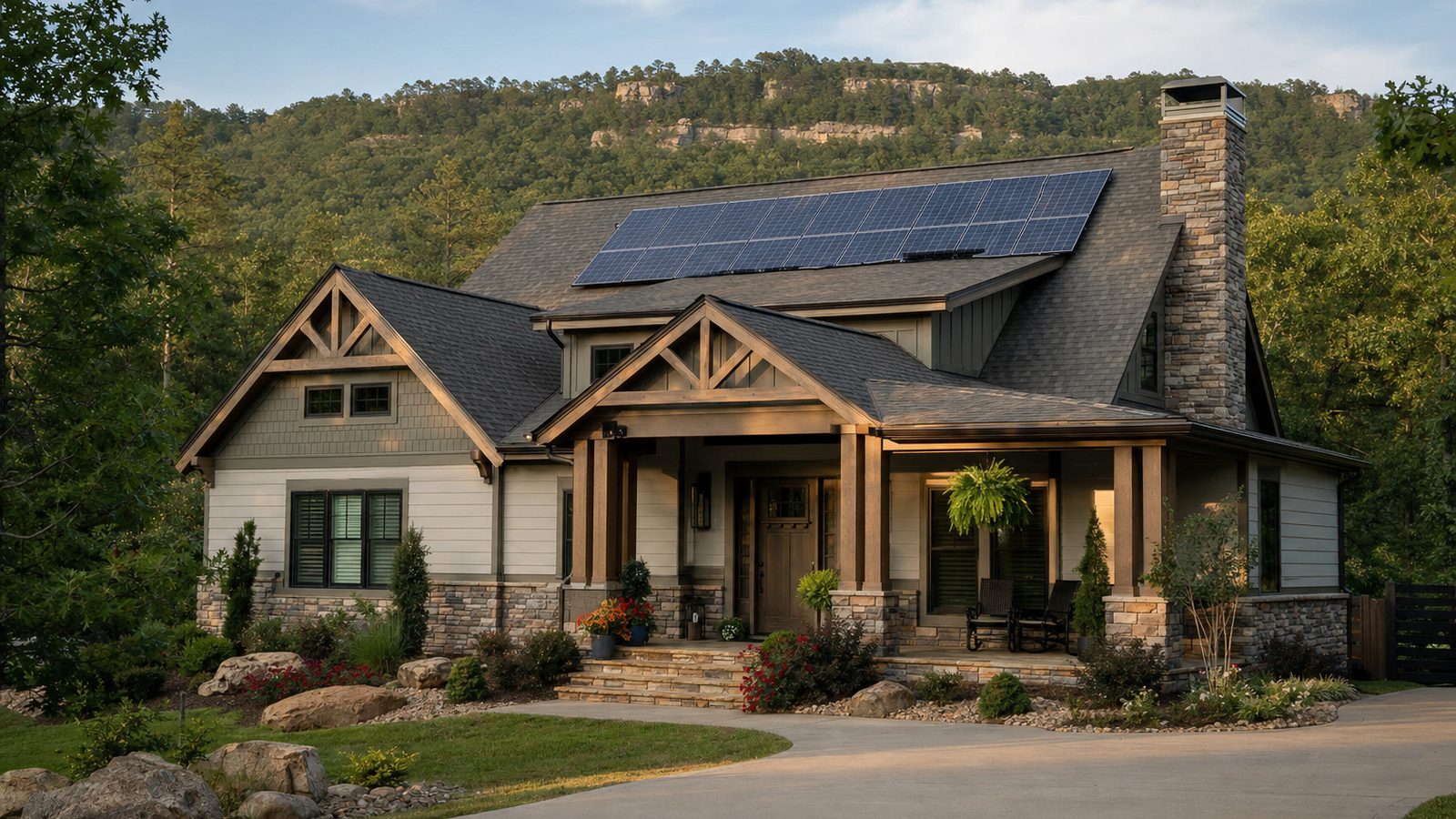
Arkansas
Arkansas solar in 2026
Arkansas has good production and comparatively low installed costs. Then Act 278 of 2023 gets involved. The law made system sizing a hard qualification issue for new customers: a residential project cannot exceed the lesser of 25 kW AC or 100 percent of the highest monthly usage in the last 12 months. Your biggest bill is now part of the permit-grade design file.
Arkansas energy costs and the sizing constraint
Using the state cash price and modeled production, a paid-off array produces electricity at roughly 6.8 cents per kWh over 25 years. The retail comparison is attractive. It is still conditional: Act 278 must permit the proposed size, and the serving utility's current compensation terms must be stated.
| Energy source | Type | Average price | What that means |
|---|---|---|---|
| Arkansas household electricity | Electricity | 14.36¢ per kWh | Statewide residential price recorded by EIA in May 2026. |
| Arkansas residential gas | Natural gas | $25.93 per Mcf | The EIA residential series for May 2026, which is roughly 8.5 cents per thermal kWh. |
| Owned Arkansas solar | Electricity | ~6.8¢ per kWh | A 25-year levelized figure built from EnergySage cash costs and PVGIS output. It values electricity used behind the meter, while exports follow the rule described below. |
May 2026 electricity data: EIA Table 5.6.A. The Arkansas residential gas value is from EIA natural gas prices; 1 Mcf works out to about 304 thermal kWh. The methodology page explains our solar calculation.
Arkansas has a remarkably even solar resource
The city range is narrow enough that a quote should not be sold on a city-name trick. Fort Smith is our high result, Little Rock the low result, and the difference is small. The project gets decided by roof reality, load history, and the legal sizing ceiling.
| Reference city | Generation in a year per kW | Modeled annual generation, 13.86 kW |
|---|---|---|
| Little Rock | 1,445 | 20,026 kWh |
| Fayetteville | 1,452 | 20,127 kWh |
| Fort Smith | 1,457 | 20,198 kWh |
| Jonesboro | 1,446 | 20,044 kWh |
Method: PVGIS v5.2 model runs by Solar Learning Lab on August 18, 2026, using the NSRDB radiation database. Assumptions: fixed roof mount, south facing, 30 degree tilt, 14 percent losses. Your roof will differ.
Act 278 turned system sizing into an eligibility test
The Arkansas PSC revised its Net-Metering Rules on September 29, 2023 through Order No. 7 in Docket No. 23-021-R to implement Act 278 of 2023, the Cost-Shifting Prevention Act. The law moved new systems into a net-billing framework. For a new residential facility, the cap is the lesser of 25 kW AC or 100 percent of the customer's highest monthly usage in the prior 12 months. A larger residential facility is allowed only when it was included in a standard interconnection agreement executed before December 31, 2022.
That is the before-and-after cliff: an older, grandfathered project can be treated differently, while a new proposal has to clear the net-billing rules and the usage-based cap. The practical move is dull but essential: hand over 12 months of bills before anyone designs the system. Do not let a salesperson size from an annual average, then discover the AC output breaches the highest-month limit. The rules do not confirm the exact current residential compensation rate, so a quote should state the utility's credit basis rather than assume one-for-one retail value.
Policy source: Arkansas PSC rules and Act 278.
Why the Arkansas bill history is a design document
Act 278 is part of a longer reset of Arkansas policy. The prior rules were revised for Act 464 of 2019, effective June 1, 2020, under Order Nos. 28 and 33. Then the Arkansas PSC adopted the current Net-Metering Rules on September 29, 2023 through Order No. 7 in Docket No. 23-021-R to comply with the Cost-Shifting Prevention Act of 2023. The policy sequence matters because old systems and new projects can sit on different sides of the transition.
For a new home system, the sizing test is not an annual total. It compares the proposed facility with the customer's highest monthly usage in the previous 12 months, then applies the lower of that figure and 25 kW AC. That makes the single largest bill in the history decisive. A contractor who begins with a generic annual-consumption formula can reach an array that looks sensible but cannot clear the rule as designed.
The exception is narrow and historical. A larger residential facility may qualify only when it was included in a standard interconnection agreement executed before December 31, 2022. Do not treat that exception as a path for a new proposal. For a current purchase, give the contractor complete bills first, ask for the calculated peak-month limit, and require the proposed capacity to be shown in AC rather than only as a DC panel total.
The utility type also changes the follow-up. The PSC rules cover Commission-jurisdictional utilities and combine net energy metering with the standard interconnection agreement process. Municipal utilities set their own limits through their governing bodies. They can go below 25 kW residential or 300 kW nonresidential only after a reliability, health, safety or welfare finding. Our research did not confirm the exact current residential compensation basis under Act 278, so a written quote should identify the utility's actual credit rate rather than imply a permanent one-for-one retail exchange.
Policy detail: Arkansas PSC rules and Act 278.
Incentive claims to leave out of the math
| Claim | Status | Why it matters |
|---|---|---|
| Arkansas homeowner program | No current program confirmed | No Arkansas credit, rebate, or tax break was confirmed for new residential solar. The binding issue is Act 278 sizing, not an incentive search. |
| Federal 25D | Ended December 31, 2025 | A provider using a lease or PPA can still claim 48E, which may influence its offered price (CRS) |
Use the calculator after the bill-history check
This calculator uses the state cost and production inputs. It cannot certify whether a proposed array fits your highest-month cap or confirm a utility-specific export credit. Treat it as a screening tool, then bring the last 12 bills to the contractor.
The Arkansas city results are unusually tight. Our PVGIS range is 1,444.9 to 1,457.3 kWh per kW per year, so tariff and system sizing drive more of the decision than city selection.
Cash quotes in Arkansas cluster near $2.46 per watt, against a $3.50 national 2024 median (LBNL). Use your quote.
Assumptions you can change
Use the rate on your actual lease or PPA quote. There is no published statewide average we trust enough to hardcode.
Cash purchase
$18,204 after state credit
- Year 1 benefit
- $128/mo
- Payback
- 11 years
- 20 year net position
- $19,188
No Arkansas state solar incentive was confirmed in our research. The practical constraint is Act 278 sizing, not a credit you can bank on.
Solar loan
$243/mo 15 yr payment
- Year 1 net
- -$115/mo
- Upfront
- $0
- 20 year net position
- -$6,427
We price loans at $3.66 per watt: the EnergySage Arkansas cash figure plus the $1.20 national loan-over-cash spread LBNL documents, because dealer fees get folded into loan pricing.
Lease / PPA
$0 down you buy the power
- Year 1 net
- -$86/mo
- Upfront
- $0
- 20 year net position
- -$22,098
A lease or PPA provider can still claim the federal 48E business credit. It does not waive Arkansas interconnection rules or the 25 kW AC residential limit.
Arkansas estimates, not quotes. Inputs use EIA Table 5.6.A, May 2026; our PVGIS production runs; and EnergySage August 2026 cost data. Act 278 makes your highest monthly usage a design input, not a sales afterthought. We are a solar installer and we also partner with other solar companies. See our disclosures.
Arkansas specifics worth acting on
- Provide a full 12-month bill history before you discuss panel count. The relevant number is the highest monthly usage, not a flattering annual average.
- Confirm the design in AC, not only DC. The stated residential ceiling is 25 kW AC, and a proposal can blur the distinction.
- If your provider is municipal, its governing body sets limits under the rules. Get its current written policy rather than relying on a statewide sales script.
- The research did not confirm a live Arkansas state tax credit, rebate, property-tax exemption, or sales-tax exemption. Keep those items out of your savings math.
Vet an Arkansas installer with the cap in hand
These scores come from EnergySage marketplace profiles, not Google. Most rest on a handful of reviews, so weigh them lightly. Compare local electrical credentials, utility-interconnection experience, and the written Act 278 sizing calculation before choosing a company.
Arkansas Energy Ventures
Little Rock, AR
5.0(6 EnergySage reviews)
Good Faith Solar
Bentonville, AR
5.0(19 EnergySage reviews)
Sunforce Solar
Serving Arkansas
5.0(12 EnergySage reviews)
Solar Alternatives Inc.
Serving Arkansas
4.6(10 EnergySage reviews)
Ratings snapshot: EnergySage marketplace, August 2026. Zero companies paid us and none are endorsed by us. No Arkansas solar-specific license authority turned up in our research. Get electrical and contractor license numbers in writing before you sign.
Price an Arkansas project carefully
Four answers create a first pass using this page's EIA and PVGIS inputs. We are a solar installer and we also partner with other solar companies. Details in our disclosures.
What does your monthly electric bill look like?
Arkansas average is $129 per month (EIA, 2024).